
Kre8or Challenges Explained: A New Creative Competition System
Kre8or is not just an AI image generation platform.
One of its most unique features is the Challenges system, which turns creativity into a structured competition with real rewards, voting mechanics, and community participation.
Instead of simply creating images and publishing them, users can now:
- Compete in themed creative challenges
- Submit entries for credit-based prize pools
- Earn rewards for participation
- Vote on other creators’ work
- Build reputation and ranking inside the system
This transforms Kre8or from a static creation tool into a dynamic competitive creative ecosystem.
How the Kre8or Challenges System Works
Inside the Challenges menu, users will find active competitions where creators can enter with their AI-generated work.
Each challenge includes:
- A theme or creative direction
- A defined entry cost
- A growing prize pool
- A submission period
- A voting phase
- A final payout structure
One example setup includes a challenge seeded with an initial prize pool (for example, $68), which grows as more users enter.

Entry System: How You Join a Challenge
To enter a Kre8or challenge:
- Open the Challenges menu
- Select an active challenge
- Submit your creation
- Pay the entry cost
Entry Cost
- Each submission costs 500 credits
These credits are not just a fee—they directly contribute to the challenge ecosystem and prize structure.
As more users enter, the prize pool increases, meaning:
The more participation, the bigger the reward potential.
Important Rule: Creators Cannot Enter Their Own Challenges
If a user creates a challenge, they cannot participate in it as a competitor.
This is intentional.
The reasoning is simple:
- Prevents unfair advantage
- Ensures equal competition
- Eliminates pre-planning bias
- Keeps voting integrity intact
However, Kre8or plans to allow trusted community members and verified creators to host challenges in the future.
This opens the door for:
- Brands hosting design contests
- Creators running community events
- Businesses sourcing creative content directly from users
Challenge Timeline: Entry Phase + Voting Phase
Each Kre8or challenge follows a structured timeline:
1. Submission Phase (7 Days)
- Creators submit entries
- Entries compete for visibility
- Prize pool continues to grow
- No voting occurs yet
This gives everyone enough time to:
- Refine their creations
- Experiment with styles
- Iterate on ideas
2. Voting Phase (5 Days)
Once submissions close:
- Entries become visible for voting
- Users begin evaluating submissions
- Rankings start forming in real time
- A live scoreboard tracks performance
This is where competition becomes active and dynamic.
The Voting System: Where Kre8or Gets Interesting
Kre8or does not use simple “like-based” voting.
Instead, it uses a pairwise voting system.
What Is Pairwise Voting?
Instead of voting on a full list of images, users are shown:
Two images at a time → “Which one is better?”
You keep choosing between pairs until:
- A ranking system emerges
- A performance score is built
- Winners are determined
This method is widely considered more accurate than traditional voting because it reduces bias and improves comparative judgment.
Why This Matters
Pairwise voting:
- Removes popularity bias
- Focuses on direct comparison
- Builds more accurate rankings
- Encourages fairer results
It ensures that the best work rises based on consensus evaluation, not just visibility.
The Kre8or Voting Economy: Earning While You Vote
One of the most unique aspects of Kre8or Challenges is that:
Voting is not just participation—it is rewarded activity.
Voters Earn a Share of the Prize Pool
A percentage of each challenge prize pool is allocated to voters.
This creates a system where:
- Creators earn for submitting work
- Winners earn top rewards
- Voters earn for participation
Everyone in the ecosystem has a role in the outcome.
Reward Structure Breakdown
While exact percentages may vary by challenge, the general structure includes:
- A portion allocated to voters
- A portion allocated to challenge host
- The majority allocated to winners
- Additional participation-based rewards
This ensures that engagement is rewarded at multiple levels.
Accuracy-Based Voting Rewards
This is one of the most advanced systems inside Kre8or.
Voters are not just rewarded for voting—they are rewarded for voting accuracy.
How it works:
- Your voting behavior is tracked
- Your choices are compared to final outcomes
- A voter accuracy score is generated
- Higher accuracy = higher rewards
Example:
- 80% voting accuracy → higher earnings
- 50% voting accuracy → lower earnings
Over time, this builds a voter reputation score, meaning:
Better judgment leads to higher rewards.
This introduces a skill-based element to participation.
Why This Voting System Is Different
Most platforms treat voting as:
- Likes
- Upvotes
- Engagement metrics
A skill-based economic activity.
This creates:
- Higher engagement quality
- More thoughtful voting
- Competitive fairness
- A reputation-based ecosystem
Hosting Challenges (Coming Expansion)
Kre8or plans to expand the system by allowing users to host their own challenges.
This will open up major opportunities for:
1. Brands
Brands will be able to:
- Launch creative campaigns
- Collect user-generated content
- Run themed design competitions
- Source marketing visuals directly from creators

2. Creators
Independent creators will be able to:
- Host niche creative contests
- Build audience engagement
- Curate community-driven art projects
3. Businesses
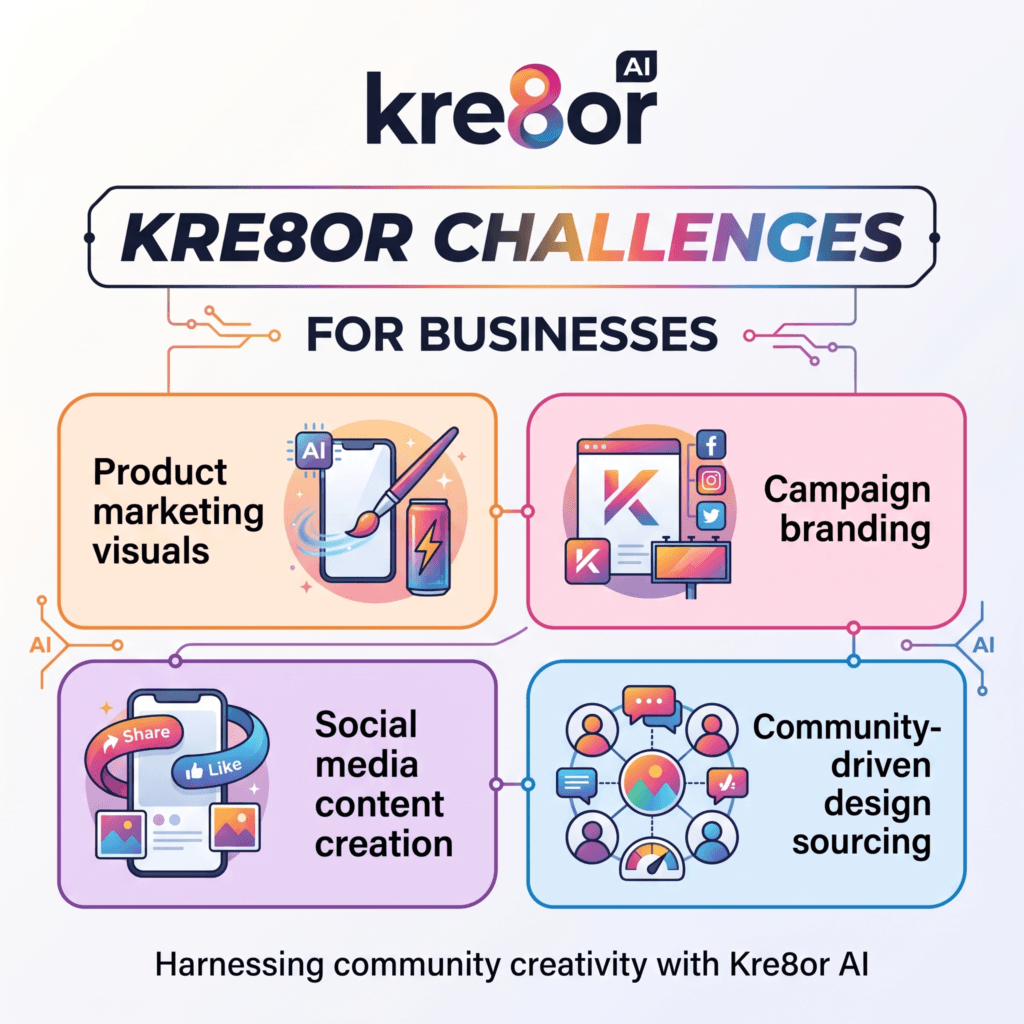
Businesses can use challenges for:
- Product marketing visuals
- Campaign branding
- Social media content creation
- Community-driven design sourcing
This turns Kre8or into more than a tool—it becomes a creative marketplace engine.
The Philosophy Behind Kre8or Challenges
Kre8or’s challenge system is built on a larger philosophy:
Creativity should be rewarded, not just consumed.
The platform is designed to address concerns around AI replacing creative work by instead:
- Encouraging participation
- Rewarding contribution
- Building creative economies
- Sharing value across users
The Core Idea
Instead of:
AI replaces creators
Kre8or aims for:
AI empowers creators to earn through participation
This is why multiple systems exist inside Kre8or:
- Affiliate rewards
- Remix credits
- Challenge prize pools
- Voting incentives
Together, they form a multi-layer creative economy.
Pros & Cons of Kre8or Challenges
Pros
1. Real Competitive Structure
Challenges have clear rules, timelines, and outcomes.
2. Skill-Based Voting
Pairwise voting reduces bias and improves fairness.
3. Multiple Reward Paths
Creators, voters, and participants all earn value.
4. Community Engagement
Encourages interaction rather than isolated creation.
5. Future Hosting System
Brands and creators will be able to launch their own challenges.
Cons
1. Credit Cost per Entry
500 credits per entry may limit frequent participation.
2. Learning Curve
New users may need time to understand voting mechanics.
3. Competitive Pressure
As the system grows, competition may become intense.
Final Verdict: Are Kre8or Challenges Worth It?
Kre8or Challenges are one of the most innovative parts of the platform because they transform AI image creation into a structured competitive ecosystem.
Instead of generating images in isolation, users can:
- Compete
- Be judged fairly
- Earn rewards
- Build reputation
- Participate in a creative economy
This shifts Kre8or from being just a creative tool into something closer to a living creative marketplace.
Bottom Line
Kre8or Challenges introduce a system where:
Creativity is no longer passive—it is active, competitive, and rewarded.
By combining:
- Entry-based competitions
- Pairwise voting
- Accuracy scoring
- Prize pools
- Future hosting capabilities
Kre8or creates one of the most unique AI creative economies currently emerging in the image generation space.